Best places in the world I visited

Bora Bora (French Polynesia)
This small island is a jewel of the South Pacific. It is one of the few places on earth that everyone hopes to see in lifetime - and I was there four times (1991, 1995, 1999 and 2003). Bora Bora is formed by an extinct volcano, surrounded by a lagoon and a fringing reef. Its summit is Mount Otemanu, located in the centre of the atoll and reaching 730 metres above sea level. It is a stunning view when one looks from a motu (islet) over the crystal-clear turquoise water to see this mountain raising. Another attraction are the traditional dances of the local people, beautifully dressed in costumes from nature, wearing smelling flowers and shell-necklaces.

Aitutaki (Cook Island)
The pristine island has the most beautiful lagoon in the world. 15 motus (islets) are sprinkled across this huge turquoise, sunlit lagoon from which mostly are uninhabited. The triangular shaped lagoon is surrounded by a barrier reef, so the water is very calm, shallow and dazzling. There are many islets with untouched palm-fringed beaches and sandbars. The most famous is the One Foot Island, which is a real paradise. The highest point Maunga Pu is only 120 metres above sea level. The traditional Islands nights are a fantastic cultural experience with authentic music and dances from the locals including children. I was in Aitutaki in 1995, 1999 and 2003.

Machu Picchu (Peru)
Machu Picchu is a 15th-century Inca citadel located in the Eastern Cordillera of southern Peru on a mountain ridge at 2’430 metres above sea level. The town sits in a saddle between two mountains. The Urubamba River surrounds the site on three sides around 450 metres lower. The buildings are built in traditional Inca architectural style of polished dry-stone walls of regular shape. The Incas were masters of this technique in which blocks of stone are cut to fit together tightly without mortar. Luckily, I visited that place which is UNESCO-World Heritage Site in 1987 when there were not yet so many tourists as today.

Iguazu Waterfall (Brazil)
The Iguazú Falls on the border between Brazil and Argentina consist of 20 larger and more than 200 smaller waterfalls over an extension of 2,7 kilometres and are in the middle of national parks. Some waterfalls are up to 80 metres high. About half of these falls converge in a gorge called the Devil's Throat, 150 metres wide and 700 metres long. On footbridges one gets very close to the thundering masses of water and gets then splashed with a noticeable spray. On a helicopter flight one can enjoy this spectacle from a different point of view. At the beginning of 1988, there weren't that many visitors, but when the falls were recognized as a World Heritage Site by UNESCO in 2013, millions of people now visit this place every year.

Singapore
This is for me the most sophisticated and beautiful city in the world. I was there first 1978 and last 2022. It is a city state but has many parks and a lot of trees along the roads. There are hundreds of tall buildings in Singapore mostly in a special architecture. But on the other side one can feel like in the deepest jungle, there are also some sandy beaches one never expected, and many well-signed trails go through forests. The city has its Chinese, Indian and Malay quarters. Singapore preserves the colonial buildings and develop new landscapes where they built modern constructions for example the Gardens by the Bay. Another wonder is the rainfall in Changi Airport, just phenomenal.

Angkor Wat (Cambodia)
This UNESCO World Heritage Site is the largest temple complex in the world and has over a thousand buildings on an area of 160 hectares. It was inhabited by about one million people at its heyday around the year 1200 (only 100’000 people lived in Paris at that time). In the main temple Angkor Wat, the towers are 65 metres high. Particularly fascinating are the extensive relief carvings, which are not only decorative, but also tell Hindu epics such as the Ramayana. On the Bayon temple huge Buddha faces are made in fine stonemasonry work. Very impressive is Ta Prohm where large roots of trees wrap around the walls in many places. I was there 2009 and 2012.

Luang Prabang (Laos)
The old capital of Laos is an UNESCO World Heritage site since 1995. It is a picturesque town located in northern Laos on a peninsula at the confluence of the Mekong and Nam Khan River. The town is famous for its cultural heritage and well-preserved architecture with a fusion of traditional Lao wooden houses and colonial European influences. Mountain ranges encircle the city in lush greenery. The many temples and pagodas are richly decorated. Famous are the alms giving ceremony to monks every early morning and the night market. Very close to the city is a stunning waterfall. I visited Luang Prabang the first time 2010, then again 2015 and 2017.
Switzerland

Zürich City
I know this city best because from my birth I lived over 50 years there. Zürich is the largest city in Switzerland and the economic and financial centre. The city in the north of the country is located on Lake Zürich and the Limmat River and is a top travel destination. The old town with its narrow streets and many historic buildings is worth seeing. The Münsterbrücke between the Grossmünster, Zürich's landmark, and the Fraumünster is a popular photo spot. One can marvel at the city from the Lindenhof or a little further away and higher from the Uetliberg, Zürich's local mountain, 870 metres above sea level. There are promenades around the lake and many parks throughout the city.

Bern City
The capital of Switzerland is located in a loop of the Aare River and has a well-preserved old town, which has been an UNESCO World Heritage Site since 1983. It is characterized by its sandstone buildings with their arcades, which extend over a length of six kilometres and form the longest covered shopping promenade in Europe. The Zytglogge is a clock tower dating back to the Middle Ages with an astronomical clock and carillon and is considered a landmark of Bern. The Federal Palace is the seat of the government and the parliament of Switzerland. From its terrace one has a beautiful view of the Alps.

Bernese Alps
South of the two lakes Thun and Brienz are the Bernese Alps with many valleys, most with touristic villages such as Grindelwald. From there it is an easy access to the mountain Männlichen from where one has a good view to the three most famous mountains: the Eiger, the Mönch and the Jungfrau, all with hights around 4’000 metres above sea level. The 1’800 metres very steep north face of the Eiger is the biggest in the whole Alps. The Jungfraujoch is with 3’000 metres above sea level the highest point in Europe one can reach by train. There are many small mountain lakes with clear water and some special high waterfalls in this region.

Valais
Valais is a canton in the south-west of Switzerland with diverse nature: from the highest mountains in Switzerland (22 are over 4’000 metres above sea level) and the largest glacier in Europe (the Aletsch Glacier with a length of 22 kilometres) to the valley of the Rhone River with its vineyards. The Matterhorn is the landmark and undoubtedly the most famous and most photographed mountain. Many villages in Valais still consist largely of centuries-old wooden houses, often in dark brown colour. There are over 8’000 kilometres of well-signposted hiking trails!

Ticino
The canton of Ticino is the southernmost part of Switzerland and is like Italy in its architecture, culture and landscape. Palm trees, cypresses, sweet chestnuts and other Mediterranean plants grow here. The two lakes Lago Maggiore and Lake Lugano are emblematic of the beauty of Ticino's nature. In my opinion, the two most enchanting places are Gandria and Morcote, both located on the shores of Lake Lugano. The largest city Lugano has beautiful promenades.

Engadin
The Engadin is in the south-east of Switzerland in the canton of Graubünden. It is one of the highest valleys in Europe and is known for its clear lakes, majestic mountains and the world-famous town St. Moritz. However, I prefer neighbouring Pontresina. The Engadin is home to the only national park in Switzerland. The Engadin houses with their mighty stone walls and funnel-shaped windows impress at first glance because of their architecture. Its soul, however, lies in the artistic decorations, the sgraffiti. A typical example of this is the village of Guarda.
Thailand

Bangkok
This is the Asian city I mostly visited in my life, the first time 1978. Since 1782, Bangkok has been the capital of Thailand. It has magnificent temples and palaces, authentic canals, tall skyscrapers, busy markets and a vibrant nightlife, but also heavy traffic congestion, intense heat, humidity and often a bad air. Bangkok has a large sky-train system, Tuk-Tuk are a famous transport possibility too. Some statistics say Bangkok is the most visited city in the world. It is a must to drive with any kind of boat on the Chao Phraya River. For me the most beautiful building is the royal temple Wat Phra Kaeo with the Emerald Buddha.

North Thailand
Bordering Laos and Myanmar (Burma), northern Thailand is known for its densely forested mountain ranges, home to several hill tribes, each with their own language and culture. The highest mountain is Doi Inthanon at 2’565 meters above sea level. The cities of Chiang Mai and Chiang Rai have many famous temples. The northernmost city in Thailand is Mae Sai. Not far from there is the Golden Triangle, where Thailand, Laos and Burma come together. Thanks to the cooler climate in northern Thailand, conifers grow there and for example also strawberries. I especially like Doi Ang Khang at the Burmese border on a hight of 1’400 metres above sea level, where King Bhumibol founded 1979 the first agricultural research station to prevent the people from cultivating opium. Since I live in Thailand, I was seven times is this Northern part, last in December 2023.

Sukhothai
In the 13th century, the kingdom of Sukhothai had its greatest expansion. The Sukhothai Historical Park is an UNESCO World Heritage Site which covers an area of approximately 70 km2 and contains nearly 200 ruins, from which some are restored. Wat Maha That is the most important temple. At Wat Si Chum is an impressive giant Buddha statue with 11 metres in wide and 15 metres high. I like that the Sukhothai ruins lay in a green area with many trees and a few small ponds. I visited Sukhothai 1994, 2017 and 2022.

Kanchanaburi
The province of Kanchanaburi in the western part of Thailand has seven national parks and many sightseeing points. Famous is the Erawan Waterfall, and same beautiful but much less known the Huay Mae Khamin Waterfall. The Death Railway, built in the Second World War with the river Kwai Bridge, the Hellfire Pass and the Krasae Cave is worth to see. Very interesting is the Tiger Cave temple on a small hill with rice fields around, sometimes full of ducks. In Sangkhlaburi at the border to Myanmar is the remarkable Mon Bridge, the longest wooden bridge in Thailand. On my trips in 2014, 2020 and 2022 I was in this wonderful province.

North East Thailand
Isan forms the northeastern part of Thailand and is not so developed for tourism. The Mekong River is the border with Laos in the north and east on hundreds of kilometres. I followed this river from his entry into Thailand in the province of Loei via the city of Nong Khai, where I was several times, until he left Thailand in the province of Ubon Ratchathani. From then on, Cambodia is the southern neighbour. A special tip which I just discovered in December 2024: In the province of Udon Thani lays the Red Lotus Lake where in the cool season Hundred thousand of red lotus flowers or water lilies bloom.

Eastern Thailand
Thailand's eastern coastal strip runs from just Bangkok all the way to Cambodia. It is famous for nice beaches and beautiful islands like Koh Chang in the province of Trat and Koh Samet in the province of Rayong. While the bigger Koh Chang is well developed and can be easy discovered by car thanks to ferries, Koh Samet as a national park is only 6 kilometres long and 2 kilometres wide, cannot be reached by car. I was 2013, 2018, 2021 and 2023 in Koh Chang, in Koh Samet only 2023. Something special is the visit of a footprint of Buddha on the top of Khao Khitchakut, over 1’000 metres above sea level in the province of Chanthaburi.
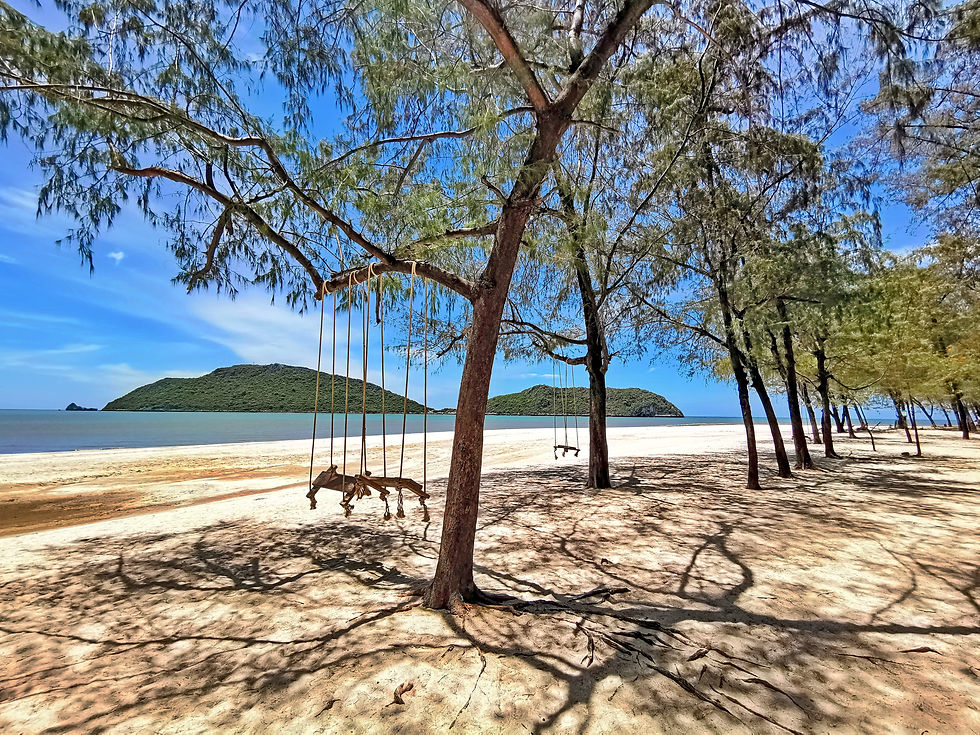
Prachuap Khiri Khan
The long stretched province has the narrowest part of Thailand, just a little over 10 kilometres from the Gulf of Thailand to the border with Myanmar. With 260 kilometres Prachuap Khiri Khan has the longest seacoast of any Thai provinces and therefore many sandy beaches. One of the best known, Hua Hin, has been a popular resort town since King Rama VII built a summer palace there. It has also a very beautiful railway station building. A special tip: The Praya Nakhon Cave in the Sam Roi Yod National Park is worth to be seen. Seven times I visited this province, last in 2024.

South Thailand
Well known tourist destinations in the South are Phuket and Koh Samui with its many sandy beaches. The two provinces of Krabi and Phang Nga have many tourist attractions such as rugged, steep limestone cliffs, beautiful caves, dense mangrove forests and over 100 islands off the coast, the most famous is surely James Bond Island but Poda Island is also highly recommended. The most spectacular view of the many islands is from the Samet Nangshe Viewpoint. Latest I was there 2024.

ความคิดเห็น